Schiaparelli Haute Couture Fall/Winter 2026–2027 Explores Creativity Through “The Call of the Void”
For its Haute Couture Fall/Winter 2026–2027 collection, Schiaparelli invited audiences into a world where uncertainty becomes a source of inspiration and imagination thrives beyond the limits of convention.

Titled The Call of the Void, the collection marked another powerful chapter in Daniel Roseberry’s ongoing exploration of surrealism, craftsmanship, and artistic experimentation.
Presented during Paris Haute Couture Week, the collection showcased Roseberry’s ability to merge the fantastical spirit of Elsa Schiaparelli with a distinctly contemporary vision. More than a display of extraordinary garments, the show unfolded as a reflection on creativity itself and the courage required to embrace the unknown.
The concept originated from the French expression l’appel du vide, which describes the mysterious impulse that draws us toward the edge of uncertainty rather than away from it. Roseberry used this idea as both inspiration and methodology, allowing instinct and intuition to guide the collection rather than relying on formulas or familiar solutions.
Following the critical acclaim of his previous couture outing, The Agony and the Ecstasy, the designer revealed that he initially believed he had discovered a reliable path to success. However, attempting to recreate that success ultimately led him to a different conclusion: creativity cannot be repeated or engineered. Instead, it emerges when artists abandon certainty and allow themselves to venture into unexplored territory.
This philosophy resonates deeply with the legacy of Elsa Schiaparelli, whose work was rooted in surrealism, contradiction, and unexpected encounters. Throughout her career, she challenged established notions of beauty and collaborated with artists who blurred the boundaries between dreams and reality. In many ways, Roseberry’s latest collection feels like a continuation of that rebellious spirit.

One of the collection’s most striking achievements was its unconventional approach to materials. Rather than relying exclusively on traditional couture fabrics such as silk, satin, and wool, Schiaparelli introduced silicone, latex, and heat-treated paint into its vocabulary of luxury.
These unexpected materials were transformed into sculptural creations that pushed the limits of craftsmanship. Silicone corsetry mimicked the appearance of skin with remarkable realism, while latex details twisted and flowed across garments like living organisms. Layers of treated paint created textures reminiscent of shells, coral, and mineral formations, reinforcing the collection’s organic and otherworldly atmosphere.
Among the standout pieces was an ultra-realistic silicone corset rendered in a delicate milky blue shade and paired with an elaborate skirt composed of hundreds of handcrafted flowers fashioned from stretched hosiery, metal wire, and pearls. The look existed somewhere between couture garment and contemporary sculpture, perfectly encapsulating Roseberry’s artistic vision.
Elsewhere, natural flowers, fish scales, and fluid latex embellishments appeared throughout the collection, creating silhouettes that felt as though they had emerged from a surreal dreamscape. The garments challenged traditional ideas of couture while remaining unmistakably Schiaparelli in their theatricality and imagination.

The colour palette drew heavily from marine life and natural landscapes. Lobster pink, vibrant orange, soft mint green, and deep violet appeared throughout the collection, often contrasted against glossy black finishes and raw ecru fabrics. These shades introduced a sense of movement and vitality while reinforcing the collection’s connection to the natural world.
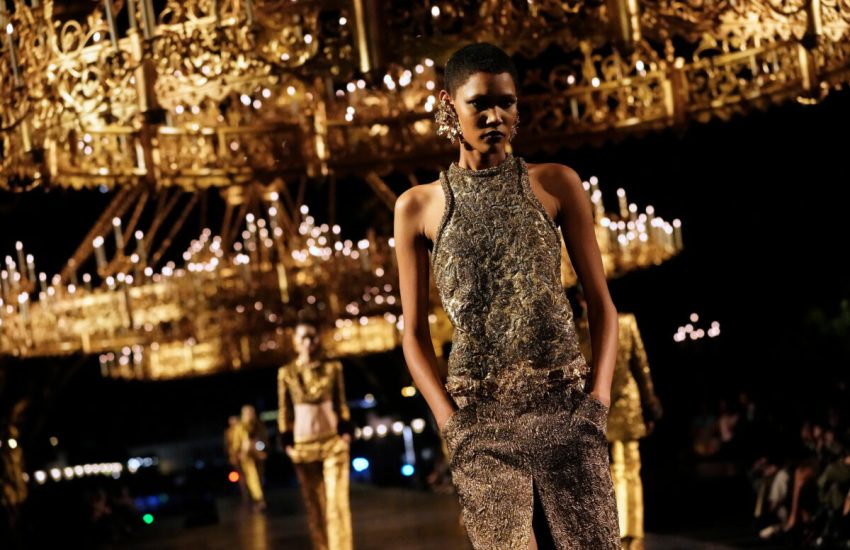
Gold, one of Schiaparelli’s most recognizable signatures, continued to play a central role. Sculptural gold embellishments appeared across jackets, gowns, jewelry, and accessories, functioning as architectural components rather than mere decoration and further emphasizing the house’s distinctive visual identity.
Roseberry also revisited some of Schiaparelli’s most iconic house codes. The signature tailored jacket returned in new interpretations featuring intricate embroidery and dramatic embellishment, transforming a classic silhouette into a statement piece that blurred the lines between fashion and art.
Accessories extended the collection’s surreal narrative even further. New versions of the Secret bag incorporated crinoline-inspired structures and floral embroidery, while the Bubble shoe received a futuristic update through the addition of silicone coverings. Jewelry designs referenced seashells, sea anemones, and octopus tentacles, continuing the dialogue between fantasy and nature that defined the collection.

Beyond its visual impact, however, The Call of the Void stands out for its conceptual depth. Roseberry uses couture not simply as a platform for craftsmanship but as a medium through which to explore humanity’s relationship with uncertainty, intuition, and creative freedom.
Perhaps the collection’s most significant accomplishment lies in its redefinition of luxury itself. Materials such as silicone and latex are employed not for provocation or novelty, but as legitimate vehicles for craftsmanship and artistic expression, expanding the possibilities of what haute couture can become.
While some looks may appear closer to gallery installations than wearable fashion, this has always been central to Schiaparelli’s identity. The house has never aimed to satisfy conventional expectations; instead, it has consistently challenged and reshaped them.
With The Call of the Void, Daniel Roseberry delivers more than a couture collection. He presents an artistic statement about risk, imagination, and the importance of embracing uncertainty. Through technical innovation and surrealist storytelling, Schiaparelli once again proves that haute couture remains one of fashion’s most powerful vehicles for experimentation and creative discovery.