Pierpaolo Piccioli Begins a New Chapter at Balenciaga With His First Haute Couture Collection
Haute couture is one of fashion’s most demanding disciplines.

Creating an entire collection by hand requires extraordinary precision, patience and craftsmanship, with individual garments often taking thousands of hours to complete. In this rarefied world, where every detail can be scrutinized down to the millimeter, designers must possess not only technical expertise but also the ability to create a sense of wonder.
Pierpaolo Piccioli has always understood that language.
For his first haute couture show at Balenciaga, the Italian designer embraced the qualities that have defined his career: dramatic proportions, expressive color, meticulous craftsmanship and a sense of romance that transforms clothing into something almost theatrical. Rather than approaching the heritage of the legendary fashion house with caution, Piccioli appeared ready to engage with it directly, bringing his own vision into conversation with one of the most influential legacies in fashion history.
The designer’s relationship with couture is well established. During his tenure at Valentino, Piccioli became known for collections that celebrated extravagance and emotion, producing extraordinary creations that regularly became some of the most memorable looks on red carpets around the world. His ability to create highly individual pieces for fashion’s most demanding clientele made couture a natural territory for his creative language. At Balenciaga, that instinct has found a new context.

The collection draws a clear connection between Piccioli’s own creative archive and the work of Cristóbal Balenciaga, the legendary Spanish couturier whose influence continues to shape modern fashion. Even during his time at Valentino, Balenciaga’s work was frequently a source of inspiration for Piccioli. His sculptural silhouettes and innovative approach to volume have long occupied an important place in the designer’s creative universe.
Now, those references have become part of the Balenciaga story itself.
Presented in the historic surroundings of La Cour d’Honneur de la Cité Internationale Universitaire de Paris, the collection immediately established its central idea: the transformation of familiar clothing into extraordinary couture.
Anok Yai opened the show wearing what, at first glance, could have been interpreted as an elevated version of a casual everyday outfit. The look featured wide beige trousers, a white top and a bomber jacket. But Piccioli transformed each element through couture craftsmanship. The trousers were made from luxurious silk, the white top took on an exaggerated, balloon-like shape, and the bomber jacket expanded around the body in a sculptural silhouette covered in vivid tangerine feathers.
It was a fitting introduction to a collection that repeatedly questioned the boundaries between ordinary dressing and haute couture.
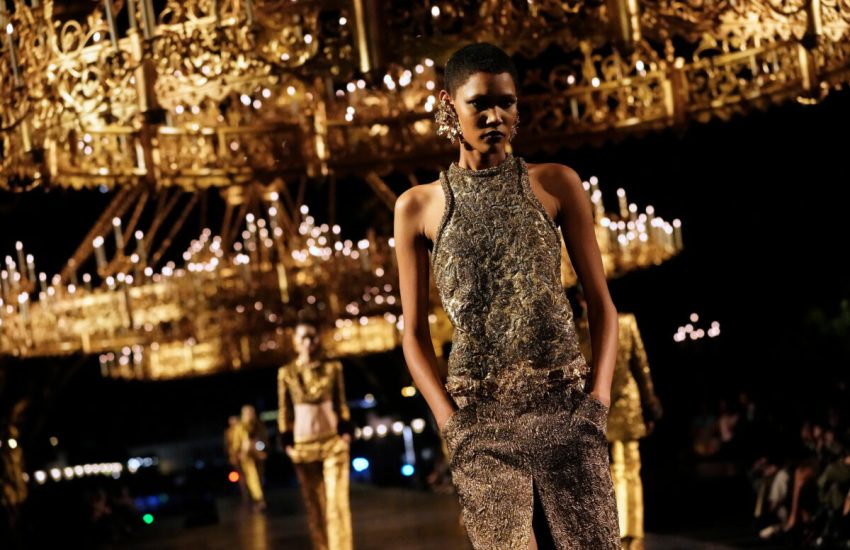
There was, of course, no shortage of spectacular eveningwear. Feathers, sequins, lace and satin appeared throughout the collection, creating the kind of extravagant gowns that have become synonymous with couture’s most fantastical moments.
Yet some of the most compelling looks came from the contrast between these elaborate elements and pieces that felt surprisingly familiar.

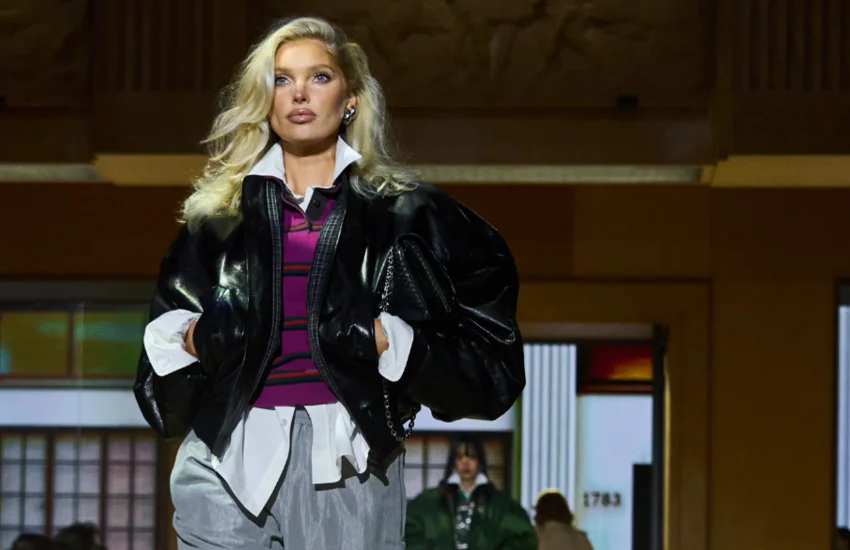
A crisp white tank top was elevated through couture construction and styled with black trousers. A voluminous white shirt was paired with a dramatic violet feathered skirt. Elsewhere, a sharply tailored black blazer was layered over a flowing white blouse and trousers finished with delicate feathers that extended dramatically from the waist to the floor.
The message was clear: couture does not have to exist in isolation from everyday fashion.
Piccioli suggested that the spirit of haute couture can be found in the way clothes are combined and worn, not only in their price or complexity. A simple tank top can become unexpectedly glamorous when styled with opera gloves. A tailored blazer can completely change the character of a grand evening gown. The idea is not necessarily to reproduce couture literally, but to borrow its attitude.
That approach also feels particularly relevant to Balenciaga, a house that has historically challenged traditional definitions of elegance and luxury.
Cristóbal Balenciaga famously closed his couture house in 1968, reportedly believing that there was no longer anyone left to dress. Nearly six decades later, Piccioli’s collection seems to offer a contemporary response to that sentiment. Rather than asking who couture is for, he appears to be asking how the extraordinary techniques of couture can respond to the way people actually dress today.

The result is a collection that looks at familiar wardrobe staples through an entirely different lens.
Piccioli’s use of color is another defining feature of the collection. Known for his bold and emotionally charged palettes, the designer introduced vibrant tones alongside softer neutrals and dramatic black. This created a visual dialogue with Balenciaga’s own history.
While Piccioli has frequently explored the expressive potential of color, Cristóbal Balenciaga was renowned for his mastery of black. The collection acknowledged this difference through a series of all-black looks that appeared almost as darker reflections of other silhouettes.
These “shadow” versions created continuity throughout the show while reinforcing the idea that Piccioli is gradually discovering his own relationship with the codes of the house.
Rather than attempting to replicate Cristóbal Balenciaga’s work, the designer seems interested in understanding its principles: the importance of silhouette, the power of volume, the transformation of the body and the ability to make clothing feel both timeless and radical.
This is perhaps the most compelling aspect of Piccioli’s debut.
He is not attempting to disappear behind the history of Balenciaga. Instead, he is using that history as a foundation from which to develop something new. His couture debut feels like an encounter between two creative worlds: the architectural precision of Balenciaga and Piccioli’s instinctive romanticism and love of extravagance.
The collection also offers an intriguing preview of what could come next. Couture has always functioned as a laboratory for fashion, allowing designers to experiment with techniques and ideas that can eventually influence more accessible collections.
As Piccioli’s vision at Balenciaga develops, it will be fascinating to see how the exaggerated volumes, unexpected styling combinations and dramatic silhouettes introduced in this collection translate into ready-to-wear.
For now, however, his first couture show delivers a confident statement of intent.

Piccioli has entered one of fashion’s most storied houses without trying to minimize its history. Instead, he has embraced the grandeur, taken inspiration from its founder and infused the collection with his own unmistakable sensibility.
The result is couture that feels lavish but not disconnected, historical but not nostalgic, and dramatic without losing its sense of modernity.
At a time when fashion often prioritizes practicality and commercial appeal, Piccioli’s Balenciaga debut makes a case for the transformative power of extravagance. These are clothes designed to provoke emotion, inspire fantasy and remind us why haute couture continues to occupy such a unique place in fashion.
At Balenciaga, Pierpaolo Piccioli appears ready to make couture feel extraordinary again—and, perhaps most importantly, to make us want to dream along with him.