Schiaparelli Spring/Summer 2026: A Vision in Shadows and Light
Daniel Roseberry’s daring new chapter at Schiaparelli turns surrealism into seduction, weaving fantasy, tension, and freedom into an unforgettable runway experience.

The Centre Pompidou dimmed to near darkness before the show began, and in that stillness, Daniel Roseberry set the stage for one of the most intriguing collections of the season. With “Dancer in the Dark,” Schiaparelli’s Spring/Summer 2026 presentation became more than a spectacle—it was a meditation on control and chaos, on how light can only truly shine when framed by shadow.
Since taking the reins at Schiaparelli, Roseberry has transformed the house into a modern playground of contrasts. His work channels Elsa Schiaparelli’s surrealism but filters it through today’s lens—provocative, cerebral, and unabashedly sensual. In this latest collection, he took the tension between rigidity and release to new heights, exploring the boundaries between the visible and the veiled. The result was a show that demanded not just admiration, but attention.
A Study in Seduction

The first look immediately set the tone: a stark black sheath traced by chalky white lines that seemed drawn in real time across the body. It was minimal yet full of suggestion—part artist’s sketch, part burlesque fantasy. This duality defined the entire show. Roseberry has an uncanny ability to make a garment whisper and shout all at once.
He leaned heavily into contrast—fragility and strength, exposure and restraint. A paper-like blouse crinkled with tension but was tailored with precision. Gold paintbrushes dangled from a structured two-piece, literalizing the concept of creative weight. And atop several looks sat lacquered, egg-shaped hats, a wink to Elsa’s love of eccentric millinery and an emblem of the house’s endless playfulness.
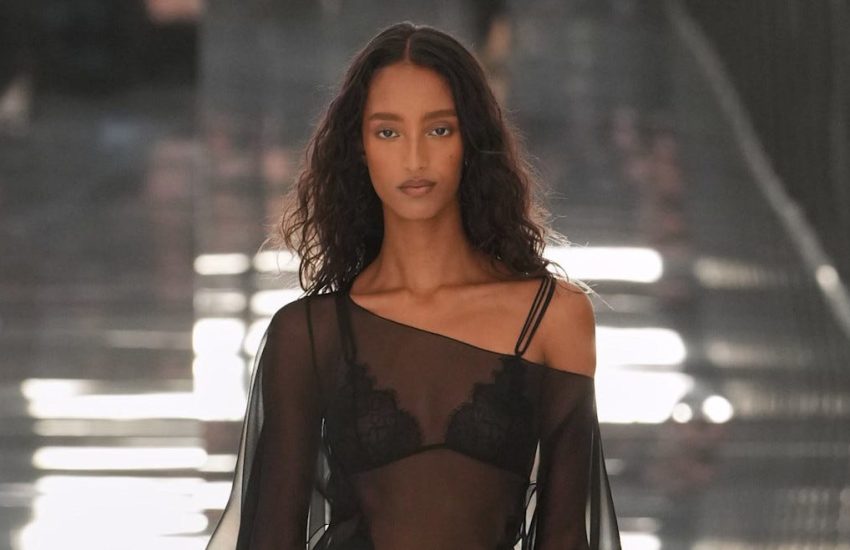
Then, the pendulum swung. Model Alex Consani drifted down the runway draped in sheer black wisps that seemed barely there, anchored only by a luminous gold cord trailing down her spine. Moments later, Kendall Jenner appeared in what might be the show’s most talked-about look—a lace thong and tufts of black ponyhair that transformed her into something almost mythological. It was bold, unapologetic, and entirely intentional. Roseberry never shocks for shock’s sake; his provocations are built on purpose.
Where Light Meets Darkness

Though its name hinted at obscurity, “Dancer in the Dark” was a collection about revelation. Roseberry used light not as decoration but as a tool for storytelling. Metallic threads caught flashes of brightness as models moved. Gold-painted fingers clutched surreal handbags. See-through gowns shimmered faintly under spotlights, exploring transparency in a way that felt poetic rather than risqué.
The designer’s fascination with duality—between the body and the art that adorns it—was palpable. His vision of sensuality has nothing to do with mere exposure. Instead, it’s about tension, about the interplay of confidence and vulnerability. Each model seemed to perform, her gestures calculated yet alive, as if she were caught in her own private choreography. The “dancer” wasn’t a character—it was every woman who moves through darkness toward her own kind of illumination.
A Modern Stage for the Schiaparelli Woman

The front row reflected Roseberry’s pop-cultural fluency. Kylie Jenner and Rosalía watched as Kendall took her turn on the catwalk, a tableau of celebrity that felt perfectly at home in Schiaparelli’s surreal world. Yet beneath the flashbulbs and fame, there was a striking intimacy to the collection. Roseberry’s clothes seem to study their wearers as much as they adorn them. Each stitch feels like a dialogue between fantasy and the human form.
One of the evening’s most memorable moments came in the form of a high-neck gown with edges that appeared to peel away, revealing glimmers of gold beneath. The effect was transformative—a metaphor for beauty discovered through imperfection. Roseberry has long been drawn to this kind of emotional texture, where fabric becomes metaphor, and fashion becomes language.
What makes Roseberry’s Schiaparelli so thrilling is his refusal to choose between the avant-garde and the attainable. His ready-to-wear borders on demi-couture—constructed with exquisite precision, yet infused with movement and wearability. The Schiaparelli woman, in his world, is both muse and maker: grounded, sensual, and fearless.
The show’s rhythm—its push and pull between heaviness and lightness—embodied what Roseberry does best. He transforms garments into living contradictions. A gown can be both armor and invitation; a hat can be sculpture and whimsy. The balance he finds between theatricality and sincerity gives Schiaparelli its renewed power.
A Legacy Reinvented

Nearly a century after Elsa Schiaparelli turned fashion into surreal performance, Roseberry carries her flame forward. He doesn’t replicate her eccentricity; he reinterprets it for a generation that craves emotion as much as aesthetics. His work doesn’t simply pay homage—it reinvents the dialogue between designer, wearer, and audience.
As applause filled the Pompidou, the message of “Dancer in the Dark” crystallized. The show wasn’t about darkness as absence, but as possibility. Roseberry’s mastery lies in his willingness to explore what lies beyond the visible, to draw light out of shadow. In doing so, he has not only redefined Schiaparelli’s identity but reaffirmed fashion’s capacity to provoke, seduce, and inspire.
Daniel Roseberry’s Schiaparelli is more than a revival—it’s a revelation. And with “Dancer in the Dark,” he proves once again that true brilliance often begins where the lights go out.