Gucci Spring-Summer 2027: Demna Gives Bourgeois Dressing a Subversive Makeover
Blending aristocratic elegance with sensuality and rebellion, Demna unveils a more fully realized vision for Gucci, challenging the conventions of luxury through a distinctly unconventional lens.
Contradiction lies at the heart of Gucci, and for Spring-Summer 2027, Demna makes it the defining principle of his latest collection. Traditional bourgeois dressing meets contemporary irreverence, as impeccable tailoring, equestrian influences, provocative silhouettes, and extravagant accessories converge in a wardrobe that questions the relationship between fashion, privilege, and personal identity. Presented in Milan on September 25, the collection signals a new chapter in the designer’s exploration of the Italian house and its enduring codes.
“Bourgeoisie is an attitude,” Demna remarked backstage, acknowledging that the conventions of aristocratic style initially pushed him beyond his familiar creative territory. Rather than embrace these traditions at face value, he approached them with the intention of disrupting their established meanings. The result is a vision built around the rebellious aristocrat: someone who possesses the privileges of an exclusive world yet refuses to conform to its expectations.
This duality shapes the entire collection. Demna considers both the outsider’s aspiration to enter elite circles and the insider’s desire to break free from their restrictions. By examining these opposing impulses, he transforms the familiar symbols of wealth and refinement into something more complex, injecting Gucci’s heritage with a renewed sense of irreverence.
The presentation itself established the appropriate atmosphere. Guests entered an expansive, polished environment conceived as a vision of Gucci’s future retail spaces. High-ceilinged rooms displayed clothing, handbags, footwear, and accessories, while passersby moved beyond the glass doors under an artificial rainstorm. More than a backdrop, the setting reflected the allure of luxury retail, where exclusivity and the desire for desirable objects remain inseparable.
The show was divided into two parts, beginning with menswear before transitioning into womenswear. The latter opened with an equestrian vocabulary that immediately established its aristocratic undertones. Close-fitting jodhpurs, sharply collared shirts, and riding boots evoked the polished aesthetic of the countryside elite. Yet Demna introduced unexpected details, including slender stiletto heels that challenged the conventional functionality of riding-inspired footwear.
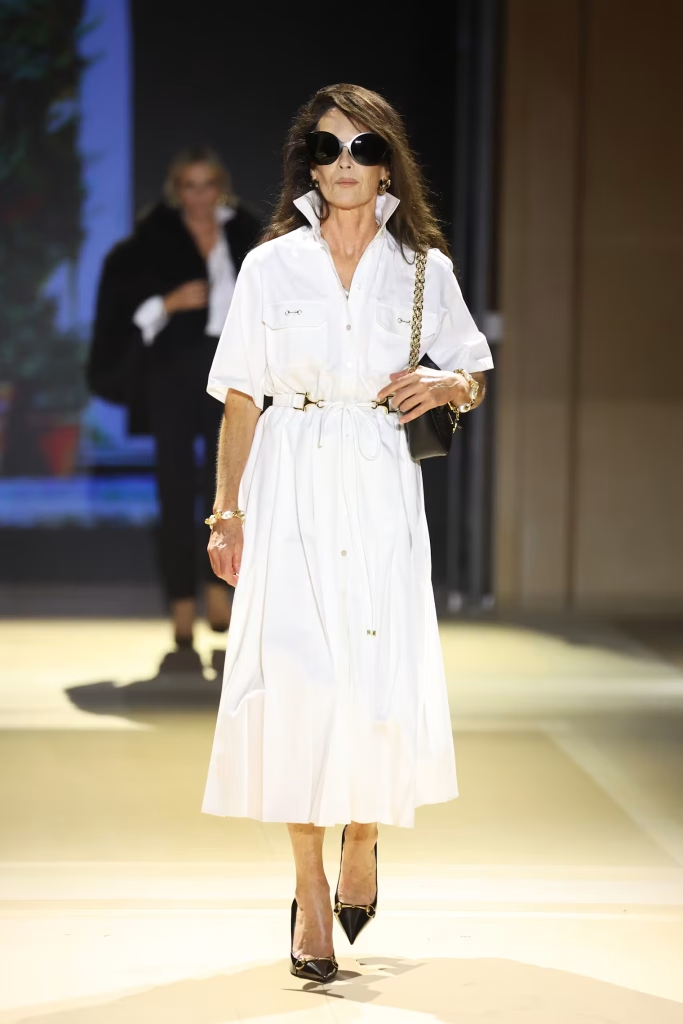
Country-club shirtdresses and trench coats continued the narrative, presented on mature models whose oversized sunglasses and abundant gold jewelry conveyed an effortless, worldly confidence. These looks celebrated a form of sophistication that transcends age, suggesting a Gucci woman who understands the rules of elegance but feels no obligation to follow them faithfully.
Tailoring offered a more restrained interpretation of the designer’s vision. Traditional suiting was reworked into elongated, sharply defined silhouettes, featuring dramatic collars and sculptural pagoda shoulders. By eliminating shoulder pads, Demna achieved a lighter construction without sacrificing the jackets’ architectural character. Narrow trousers, capri pants, and pencil skirts reinforced the streamlined proportions, creating a modern alternative to the more exaggerated shapes often associated with power dressing.
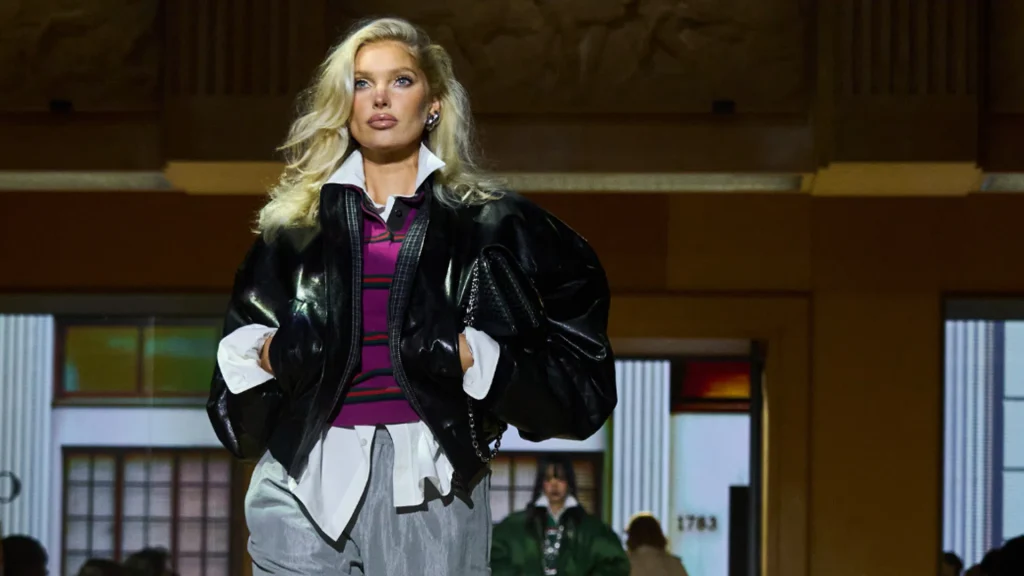
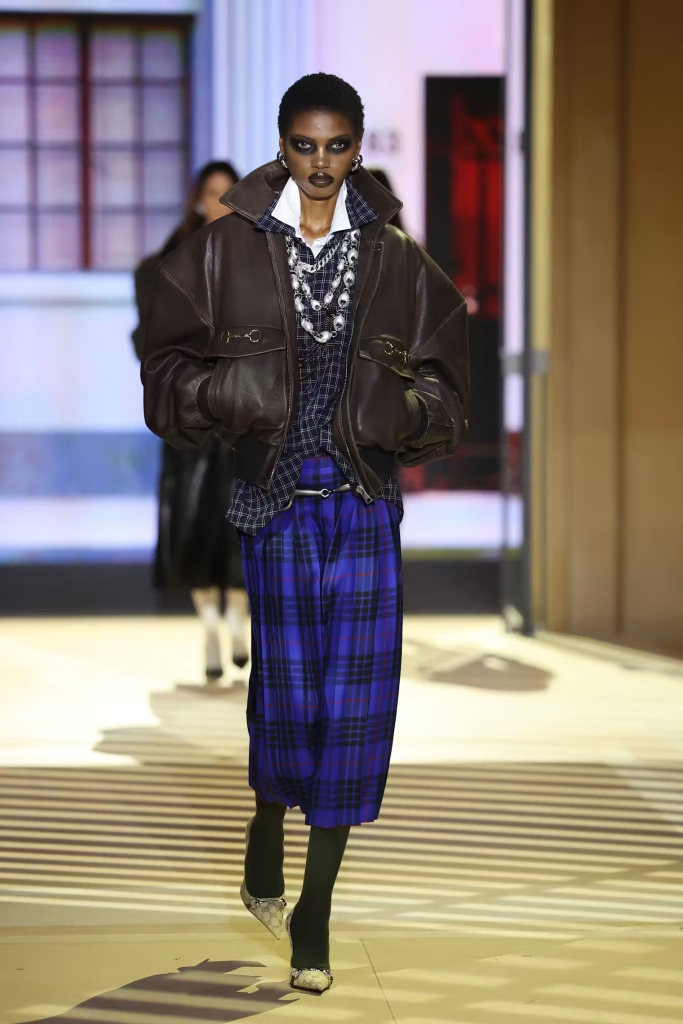
The collection became increasingly playful as familiar wardrobe staples were combined in unexpected ways. Rugby shirts were paired with pleated tartan skirts, while rounded bomber jackets introduced volume and contrast. Oversized belts featuring prominent horsebit details served as defining accessories, accompanied by layers of jewelry that embraced a deliberate sense of excess.
Demna described the inspiration as the attitude of an aristocratic schoolgirl who resents the prestigious institution she attends. That image captures the collection’s central tension: the uniform of privilege becomes an instrument of defiance. Preppy conventions remain recognizable, but their traditional authority is undermined by unconventional styling and an unapologetically rebellious spirit.
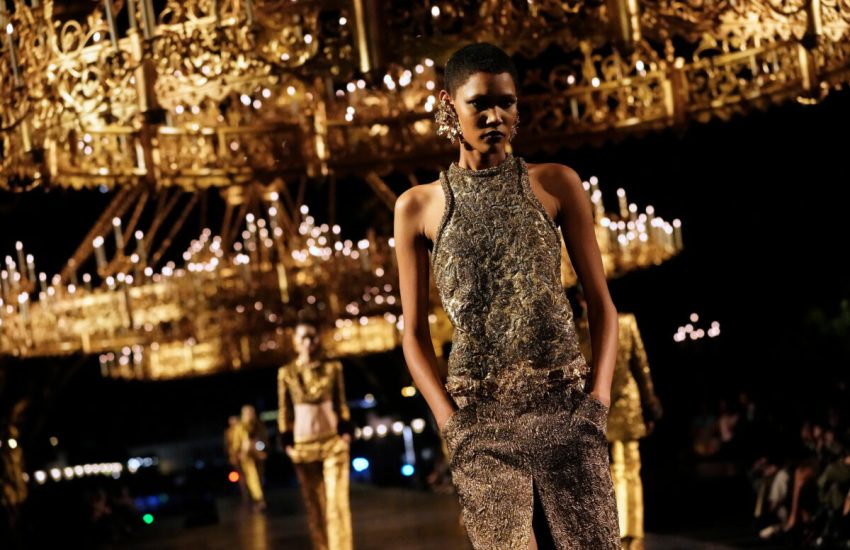
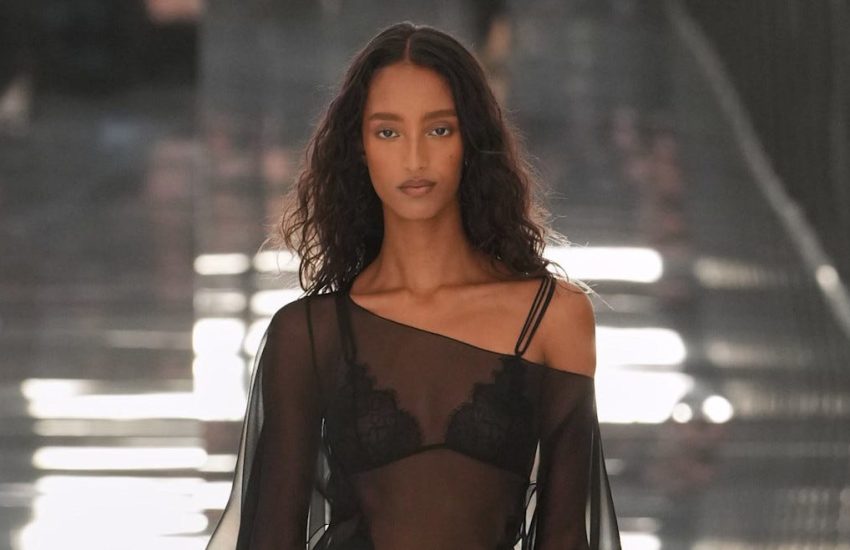
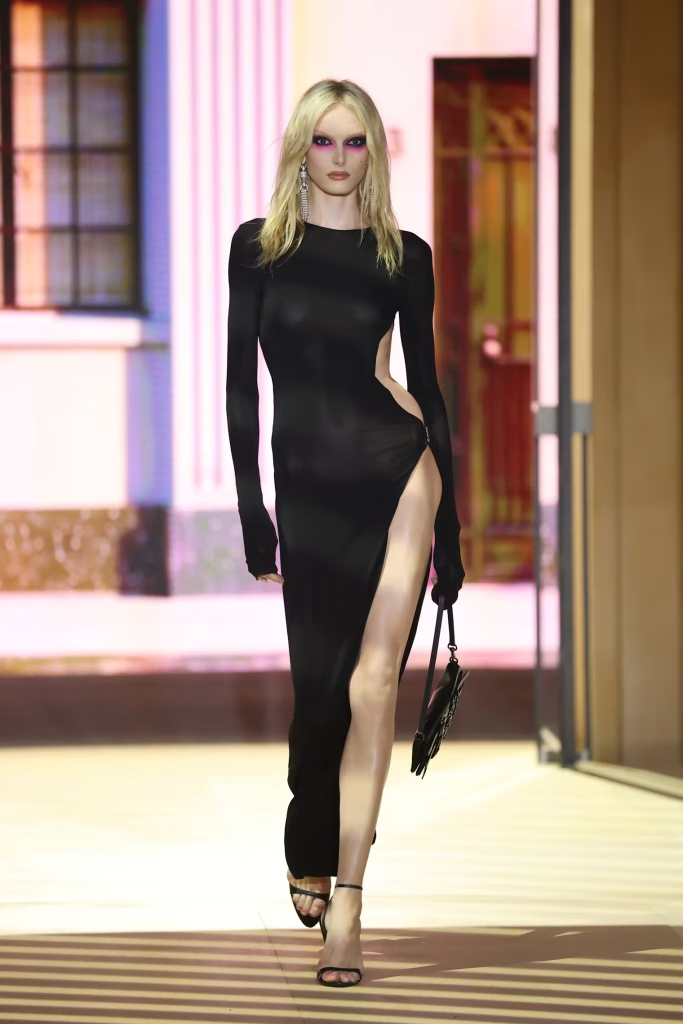
For evening, the mood shifted toward unapologetic glamour and sensuality. Alex Consani, Anok Yai, Candice Swanepoel, and Rosie Huntington-Whiteley were among the supermodels showcasing designs that celebrated the female form while concealing sophisticated construction beneath their seemingly effortless surfaces. The pieces reflected Gucci’s ability to combine seductive simplicity with meticulous craftsmanship.
The closing look provided a particularly compelling expression of this approach. A delicate pinkish-beige dress appeared to rest almost weightlessly against the model’s body, its fabric falling over one shoulder and anchored by a silver, droplet-shaped embellishment at the back. Rather than relying on elaborate ornamentation, the design drew its impact from precise draping, movement, and the subtle interplay of gravity and fabric.
Beyond the individual looks, Spring-Summer 2027 demonstrates how Demna’s interpretation of Gucci has evolved. His earlier film, The Tiger, explored the house’s flamboyant personalities and distinctive historical imagery. Fall 2026 focused more directly on sensual, body-conscious silhouettes, while the Resort 2027 presentation in New York examined the concept of a complete Gucci wardrobe, extending the conversation into everyday luxury.
This latest offering brings those explorations together in a more unified vision. Heritage, practicality, sexuality, and eccentricity exist alongside one another, creating a wardrobe that resists easy categorization.
Ultimately, Demna’s challenge is to make Gucci’s established codes relevant to a new generation without diminishing their cultural significance. His Spring-Summer 2027 collection suggests that the future of the house depends not on abandoning tradition, but on questioning it. Here, elegance is never entirely conventional, privilege carries a rebellious undertone, and luxury becomes a means of expressing individuality rather than simply communicating status.
With this collection, Demna offers a Gucci defined by confidence, contradiction, and a willingness to challenge its own conventions. The house’s recognizable identity remains firmly intact, yet its familiar language acquires a different meaning: bourgeois dressing is no longer merely about belonging to an exclusive world, but about having the confidence to rewrite its rules.